
The Fake Rolex Cyclops lens test is one of the most reliable methods for distinguishing a genuine Rolex from a replica or counterfeit. This small, dome-shaped magnification lens positioned above the date window on the dial has been a Rolex hallmark since 1953, and its optical properties are extremely difficult to replicate convincingly at low cost. If you know exactly what to look for when performing a Rolex Cyclops lens test, you can quickly identify whether you are looking at a real watch or a fake — and this guide covers every detail of how that test works in practice.
What Is the Rolex Cyclops Lens?
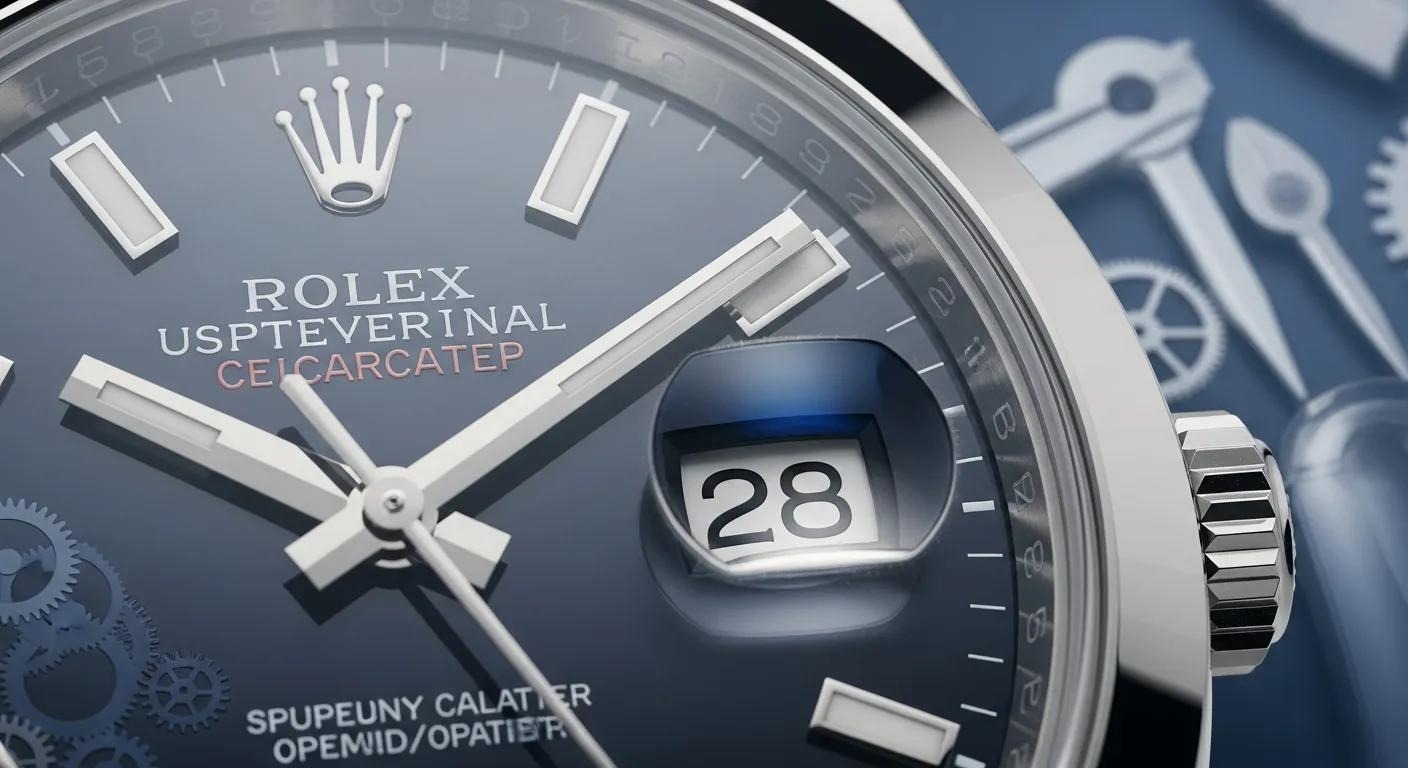
The Cyclops lens is a small convex magnifying lens set into the sapphire crystal of most Rolex Datejust, Date, and Datejust II models, positioned directly over the date aperture. Its purpose is purely functional: to magnify the date display for easier reading. However, its precise optical characteristics have become one of the most scrutinized authentication details in the watch world.
On a genuine Rolex, the Cyclops lens magnifies the date at exactly 2.5x magnification. This means the date numeral appears significantly enlarged, filling most of the visible date window when viewed from directly above. The magnification is so pronounced that the date seems to almost leap off the dial toward the viewer.
Understanding the Cyclops lens is essential context for anyone interested in the replica Rolex Submariner and related models, since the lens appears on many of the most popular Rolex references and is consistently one of the first authentication points examined by experienced collectors.
The Rolex Cyclops Lens Explained: Real vs Fake Magnification Test 2026: Step by Step
Performing the Rolex Cyclops lens test correctly requires nothing more than your eyes and good lighting. Follow these steps to get an accurate result every time.
Step 1: Position the Watch Correctly
Hold the watch face-up and look directly down at the date window from above. The Cyclops lens must be viewed from a perpendicular angle to assess its magnification accurately. Viewing at an angle will skew your perception of the magnification level and may produce a false reading in either direction.
Step 2: Assess the Magnification Level
On a genuine Rolex, the date numeral should appear large, clear, and centered within the date window at 2.5x its actual size. The number should fill the visible aperture substantially. If the date appears small, only slightly enlarged, or sits too low within the aperture, the magnification is insufficient and the lens is not genuine Rolex quality.
Step 3: Check Clarity and Color Rendering
A genuine Rolex Cyclops lens produces crisp, undistorted magnification with no color fringing or aberration around the edges of the numerals. The magnified date should appear sharp at its center. Inferior lenses may show chromatic aberration, blurring at the edges, or a washed-out appearance that betrays cheaper glass or plastic construction.
Step 4: Examine the Lens Profile from the Side
The profile of the Cyclops lens should be a clean, smooth dome rising above the flat plane of the sapphire crystal. On genuine Rolex pieces, the dome is symmetrical and sits in exact proportion to the date window below. Replicas often get the dome shape slightly wrong — either too flat, too tall, or asymmetrically positioned over the aperture.
Real vs Fake Cyclops Lens: Key Differences
Here is a direct comparison of what you will find on a genuine Rolex versus a fake or replica watch when examining the Cyclops lens carefully.
Magnification: 2.5x vs. Less Than 1.5x
This is the most immediately obvious difference. A genuine Rolex Cyclops lens produces 2.5x magnification. Most fakes — even expensive replicas — produce 1.5x or less. The difference is visible instantly. When you look at a real Rolex date window, the number looks dramatically enlarged. On a fake, it looks only slightly bigger than it would without the lens at all.
This discrepancy exists because producing a true 2.5x magnification lens in the correct dome profile, bonded to sapphire crystal, is technically demanding and expensive. Budget replica manufacturers substitute inferior lenses that approximate the visual look of the Cyclops but cannot replicate its optical performance.
Date Centering and Fill
On a genuine Rolex, the magnified date fills the visible date window neatly, appearing centered both horizontally and vertically. On many fakes, the magnified date appears off-center, floats too high within the window, or is partially obscured by the window edges because the lens is positioned incorrectly relative to the aperture.
Edge Sharpness
The boundary between the Cyclops lens and the surrounding crystal on a genuine Rolex is crisp and defined. On many replicas, this boundary shows small irregularities, adhesive residue, or slight misalignment that reveals the lens was added separately rather than being an integral part of the crystal construction.
How High Quality Replicas Handle the Cyclops Lens
The Cyclops lens is one area where even high quality replica watches vary considerably. Some of the better replica manufacturers have improved their lens quality substantially in recent years, getting closer to the 2.5x magnification of the genuine article. However, truly replicating the optical performance of a Rolex Cyclops lens remains one of the most difficult technical challenges in replica watchmaking.
When evaluating the best replica Rolex watches in 2026, the Cyclops lens is consistently cited as one of the hardest details to perfect. Buyers should specifically ask about magnification level when considering a replica Datejust or Date model, as this single detail makes an enormous difference in how convincing the watch looks in person.
For those exploring the fake Rolex Datejust market specifically, the Cyclops lens is the first thing experienced buyers examine. A Datejust replica with poor Cyclops magnification immediately signals lower build quality across the board, since manufacturers who cut corners on the lens typically cut corners elsewhere as well.
The Cyclops Lens in the Broader Context of Rolex Authentication
The Cyclops lens test is valuable precisely because it is quick, requires no tools, and provides an immediate visual result. However, it is most effective when used as part of a broader authentication process rather than as a standalone test.
According to the official Rolex website, the brand recommends that any authenticity concerns be directed to an authorized Rolex service center, where trained professionals can examine every aspect of the watch including the movement, serial numbers, and materials.
For a comprehensive understanding of how to authenticate a Rolex beyond the Cyclops test, the guide on how to spot a fake Rolex covers 15 expert authentication tells that work together to build a complete picture of a watch’s genuineness. The Cyclops lens is one chapter in that larger authentication story.
If you want an even more rigorous framework, learning how to know if a Rolex is original through seven definitive tests gives you a systematic approach that no single indicator alone can provide. Authentication is most reliable when multiple independent tests all point to the same conclusion.
Common Mistakes When Performing the Cyclops Lens Test
Even experienced buyers sometimes draw incorrect conclusions from the Cyclops test because of avoidable errors. Here are the most common mistakes and how to avoid them.
Viewing at an angle is the most frequent error. The 2.5x magnification of a genuine Rolex is only apparent when viewing the lens straight on from above. At an angle, even a genuine Cyclops lens will appear to show less magnification, potentially leading a buyer to incorrectly flag a real watch as suspect.
Poor lighting is another common issue. The Cyclops test works best in good ambient light or under a direct light source. In dim conditions, the contrast between the magnified date and the surrounding dial is reduced, making it harder to assess magnification level and clarity accurately.
Finally, some buyers compare the Cyclops on a Datejust to one on a Submariner and expect them to look identical. Not all Rolex models feature the Cyclops lens — and on those that do, slight variations in dome profile can exist between different reference years. Always compare against the specific reference you are evaluating.
The Cyclops Lens and Replica Watch Value
From a buyer’s perspective in the replica market, the quality of the Cyclops lens is a useful proxy for overall replica quality. Vendors who have invested in better Cyclops lens technology tend to invest in better movements, better bracelet construction, and better dial printing across the board.
When you shop replica watches, pay close attention to product photography that specifically shows the date window and Cyclops lens from directly above. A trustworthy vendor will provide these detail shots because they know their lenses perform well.
The price tier of a replica also correlates with Cyclops quality. Understanding how much does a fake Rolex cost at various quality levels helps set realistic expectations — entry-level replicas almost never feature convincing Cyclops magnification, while mid-tier and premium replicas get progressively closer to the genuine article’s performance.
Buyers particularly concerned with Cyclops authenticity should also read the guide on best quality fake Rolex watches, which specifically evaluates Cyclops lens performance as part of its assessment methodology. This level of detail helps buyers understand exactly what they are getting before committing to a purchase.
Frequently Asked Questions
What magnification does a real Rolex Cyclops lens have?
A genuine Rolex Cyclops lens magnifies the date at exactly 2.5x. This means the date numeral appears two and a half times larger than its actual size when viewed straight on from above the watch. This level of magnification is immediately noticeable and dramatically different from the 1.5x or less magnification found on most replica and counterfeit watches. The 2.5x specification has been consistent across genuine Rolex Cyclops lenses for decades.
Can a fake Rolex pass the Cyclops lens test?
Budget and mid-range fakes almost never pass the Cyclops lens test due to insufficient magnification. Some premium high quality replicas get much closer to the 2.5x mark, but achieving truly identical optical performance remains technically difficult. The Cyclops test is a reliable first pass — though it should always be combined with other authentication methods for a definitive conclusion.
Does every Rolex model have a Cyclops lens?
No. The Cyclops lens appears only on Rolex models that feature a date display, such as the Datejust, Date, and Day-Date. Models without a date complication — such as the no-date Submariner and the Milgauss — do not have a Cyclops lens. The Submariner Date version does feature the Cyclops, which is an important distinction when authenticating that specific reference.
Is the Cyclops lens made of glass or sapphire?
On genuine Rolex watches, the Cyclops lens is made from the same synthetic sapphire crystal material as the main watch crystal. Sapphire is used because of its extreme hardness (rated 9 on the Mohs scale), scratch resistance, and optical clarity. On replica watches, the Cyclops lens is typically made from mineral glass or plastic, which is softer, more prone to scratching, and produces inferior optical clarity over time.
What should I do if I am unsure about a Rolex Cyclops lens after testing?
If the Cyclops test leaves you uncertain, bring the watch to an authorized Rolex dealer or a certified independent watchmaker with Rolex experience. They can examine the movement serial number, caseback engravings, and bracelet construction to provide a comprehensive authentication assessment. Online authentication services that accept high-resolution photographs are also available and can provide useful second opinions before investing in a professional examination.