

- Watche Guides
- Comments:5
How to Spot a Fake Rolex Datejust: Authentication Guide
Learning how to spot a fake Rolex Datejust is an essential skill for any prospective buyer in the pre-owned luxury watch market. The Datejust is the world’s most replicated Rolex — its classic, enduring design has been copied at every quality tier from crude $20 street fakes to near-flawless super clones priced at over $1,000. Knowing what to look for before you hand over your money can save you from an expensive and deeply disappointing mistake.
This comprehensive authentication guide walks you through every major checkpoint: the dial, crystal and Cyclops lens, bezel, bracelet, movement, caseback, and serial numbers. By the end, you will have a systematic process for evaluating any Rolex Datejust you encounter.
Why the Rolex Datejust Is a Prime Target for Counterfeiters
The Rolex Datejust has been in continuous production since 1945 — making it one of the longest-running watch models in history. Its versatile, dress-sport design means it suits virtually every occasion, which is why it remains Rolex’s best-selling reference year after year.
This popularity is precisely what makes it the most counterfeited luxury watch on earth. Fake Datejusts appear everywhere: online marketplaces, street vendors, unscrupulous second-hand shops, and even in seemingly legitimate private sales. Anyone who buys pre-owned Rolex watches needs to know how to spot a fake Rolex Datejust before committing to a purchase.
How to Spot a Fake Rolex Datejust: The Dial
The dial is your first and most revealing inspection point. Genuine Rolex craftsmanship is visible at every level of dial production, and fakes almost always show deficiencies here.
- Logo and text printing quality: On a genuine Datejust, the Rolex crown logo and all dial text are applied with extreme precision. The letters are three-dimensional, slightly raised from the dial surface, with perfectly consistent spacing. On fakes, the printing is flat, the spacing is irregular, or the edges of the letters appear soft and blurry under magnification.
- Applied hour markers: Genuine Datejust hour markers are individually applied pieces of solid gold or white gold. They are three-dimensional, have crisp edges, and sit flush against the dial at identical heights. Fakes use printed markers, flat stamped pieces, or poorly fitted applied markers that sit at inconsistent angles.
- Lume quality and alignment: Rolex uses its proprietary Chromalight material — a long-lasting blue lume — applied perfectly within each hour marker and both hands. On fakes, the lume overflows its borders, shows bubbles, or is applied unevenly. Misaligned hands are also a common tell on lower-grade fakes.
- Dial surface quality: Authentic Datejust dials have rich, consistent color. Common variants like the sunburst silver dial show a radiating finish that changes subtly as the watch moves in light. Fakes typically produce flat, dull, or inconsistently colored dials that lack this depth.
For a broader understanding of authentication indicators across all Rolex models, our guide to how to spot a fake Rolex covers 15 expert tell-tale signs.
The Cyclops Lens: How to Spot a Fake Rolex Datejust Instantly
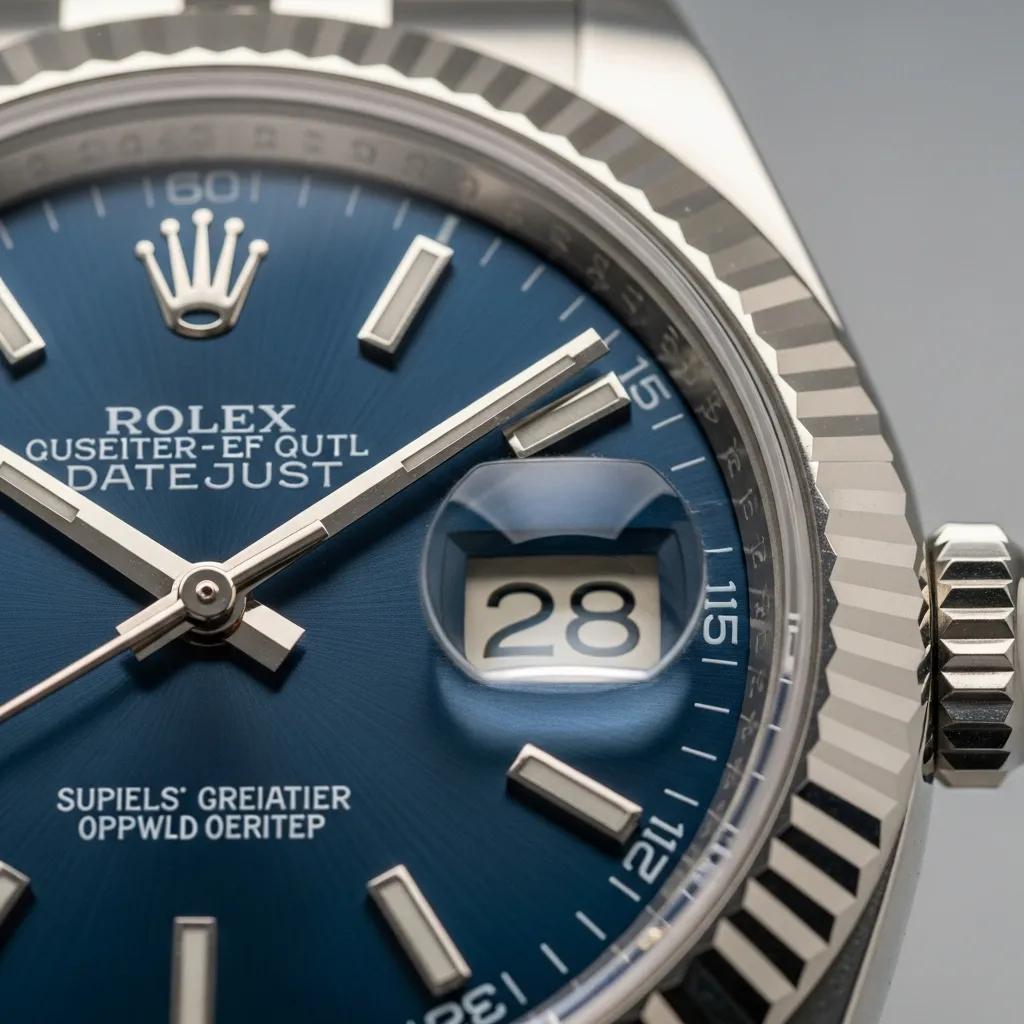
The Cyclops lens is arguably the most famous and most reliable single authentication test for any Datejust. It is the magnification bubble built into the sapphire crystal, positioned directly over the date window.
On a genuine Rolex Datejust, the Cyclops provides exactly 2.5x magnification. When you look through it, the date numeral appears large, crisp, and fills the aperture. The transition between the Cyclops and the flat crystal around it is seamless and clear.
On the overwhelming majority of fake Datejusts, the Cyclops performs poorly:
- No magnification at all (the date appears normal size)
- Weak magnification of 1x to 1.5x
- The date appears blurry or distorted
- The date is off-center or too small within the aperture
This test alone will identify the majority of fake Rolex Datejust watches within seconds. Carry out this check first any time you are evaluating a Datejust.
Bezel and Crystal Inspection
- Bezel: The Datejust comes with a variety of bezel types: smooth, fluted, or gem-set. On genuine examples, the fluted bezel has razor-sharp ridges that reflect light in precise, even flashes. A fake fluted bezel typically shows softer, less defined ridges that reflect light unevenly.
- Gem-set bezels: Genuine Rolex gem-set bezels have stones that sit perfectly level, uniformly spaced, and identically sized. Fakes using simulated stones often show misaligned settings, uneven stone sizes, or synthetic stones of obviously inferior quality.
- Crystal clarity: Genuine Rolex uses scratch-resistant sapphire crystal with an anti-reflective coating on the inside. The crystal should appear nearly invisible when viewed at an angle — showing only a faint blue-green reflection. Fakes using mineral crystal or lower-quality sapphire often show stronger, white reflections.
The Bracelet: A Critical Check When Learning How to Spot a Fake Rolex Datejust
The Datejust is typically paired with either the Jubilee bracelet (five-piece link construction) or the Oyster bracelet (three-piece link construction). Both are extraordinarily well-made on genuine pieces and are difficult to replicate at low cost.
- Weight and drape: Lift the watch and let it rest across your palm. A genuine Datejust bracelet has substantial weight and flows naturally. Fake bracelets often feel light, rigid, or plasticky by comparison.
- Link finishing: Genuine Rolex Jubilee and Oyster bracelets alternate between brushed and polished link surfaces with razor-sharp transitions. Fakes typically blur the transition between finishes, producing a muddier, less defined result.
- Bracelet articulation: Each link of a genuine Rolex bracelet moves smoothly and independently. There should be no grinding or catching. Fake bracelets frequently have stiff, poorly fitting links that catch or bind.
- Clasp: The Crownclasp or Oysterlock clasp should fold open and close with a definitive, satisfying snap. The folded clasp should be flat and smooth, with the Rolex crown and “ROLEX” text deeply and evenly engraved. Fake clasps are often loose, imprecisely engraved, or click without confidence.
For buyers exploring what the best replica manufacturers produce for comparison purposes, our collection at shop replica watches gives a full picture of the current market.
Rehaut Engraving
This is one of the most reliable and least well-known authentication points. Since approximately 2002, every genuine Rolex has the word “ROLEX” laser-engraved repeatedly around the inner bezel ring (rehaut), in tiny, perfectly precise text aligned with every minute marker.
To check the rehaut, tilt the watch slightly and look at the inner bezel edge at an angle. On genuine watches you will see rows of crisp, tiny “ROLEX” text all the way around. On fakes:
- The rehaut engraving is absent entirely
- The text is present but blurry or incorrectly sized
- The spacing is uneven
This check requires no special tools and takes about five seconds once you know what to look for.
Movement: The Definitive How to Spot a Fake Rolex Datejust Test
If any other test leaves doubt, the movement is the final, definitive authority. Modern Rolex Datejust watches use the Caliber 3235 movement, which beats at 28,800 vph and provides the characteristic near-continuous sweep of the seconds hand.
- Seconds hand sweep test: Watch the seconds hand for 15–30 seconds. A genuine Rolex Datejust sweeps with approximately 8 micro-steps per second — so smoothly it appears to glide. A quartz movement ticks once per second. Lower-grade automatic movements (common in mid-range fakes) beat at 18,000 or 21,600 vph, producing 5 or 6 steps per second — noticeably less smooth.
- Winding feel: Gently unscrew and wind the crown. On a genuine Datejust, manual winding has a precise, even resistance. Fakes often wind with an uneven, gritty, or overly stiff feel.
- Date change mechanism: The quickset date function on a genuine Datejust changes the date by pulling the crown to the middle position and turning it. The date jumps cleanly and precisely. Fake quickset mechanisms are often imprecise, requiring force, or the date change is sluggish.
For more information on distinguishing genuine Rolex calibers from cloned movements, our in-depth guide on how to know if a Rolex is original details seven definitive tests.
Serial and Reference Number Checks
Every genuine Rolex has two sets of engravings between the lugs:
- Serial number (6 o’clock lug): Unique to each watch; determines production year
- Reference number (12 o’clock lug): Identifies the model and configuration
On genuine Rolexes, both are laser-engraved to a fine, sandblasted finish that appears to glow when light hits it at an angle. Counterfeit engravings are typically:
- Shallower and less defined
- Produced by acid etching rather than laser engraving (smoother, glassy surface)
- Containing serial numbers outside the genuine production range
You can verify production date ranges against published Rolex serial number charts on Wikipedia to confirm whether the claimed year matches the serial.
For deeper guidance on using serial numbers as part of a full authentication process, see our guide on how to know if a Rolex is original.
Caseback Authentication
The caseback on a genuine Rolex Datejust is a solid Oyster caseback — no exhibition window, no clear back. It is engraved with the Rolex crown logo and reference information. It screws down firmly and seamlessly into the case.
Any Datejust with a clear, see-through caseback is not genuine. This is a design choice Rolex does not make on the Datejust line. Beyond this obvious tell, check that the caseback engravings are deep and precise, not shallow acid-etched marks.
Comparing to Known Replicas
Understanding what the best replicas look like helps sharpen your eye for the real vs. fake comparison. Our comprehensive guide to the fake Rolex Datejust covers the top replica options and specifically identifies which details even high-quality replicas typically fail to perfect.
For the broader context of what makes the best replicas worth considering, our rundown of the best quality fake Rolex options highlights the manufacturers who come closest to replicating genuine Rolex quality.
If you are also evaluating a Submariner alongside a Datejust, the same core methodology applies — with model-specific differences. Our guide to the replica Rolex Submariner explains the differences in detail.
For an overview of the top replica-quality Rolex models across all references, our curated list of the best replica Rolex watches is a helpful reference point.
To understand what you should expect to pay at each quality tier of the replica market, our pricing guide on how much does a fake Rolex cost breaks down the full range from street-level fakes to high-end super clones.
Frequently Asked Questions
How do I spot a fake Rolex Datejust without opening it?
You do not need to open the watch to identify most fakes. The Cyclops lens test (2.5x magnification on genuine), seconds hand sweep (smooth glide vs. tick), rehaut engraving (laser-engraved text on genuine), bracelet weight and articulation, and dial printing quality are all external checks that will identify the vast majority of counterfeits without any tools.
What does a fake Rolex Datejust feel like compared to a real one?
A genuine Datejust feels dense, substantial, and premium from the moment you hold it. The bracelet flows smoothly, the crown screws down with confidence, and the case has crisp, sharp edges. A fake typically feels lighter, with a bracelet that moves rigidly or rattles slightly, and a crown that does not screw down properly.
Do all fake Rolex Datejust watches have quartz movements?
No. Many mid-range and high-end replicas use automatic movements — sometimes clones of the ETA 2824 or even Rolex-clone calibers. However, even these movements produce a less smooth sweep than the genuine Rolex caliber and can be identified by feel, sound, and visual inspection of the winding and date mechanisms.
Is there a fake Rolex Datejust that is truly impossible to tell apart from the real thing?
No fake Datejust is impossible to distinguish from a genuine one when a proper expert inspection is conducted. The movement, movement finishing, dial quality, rehaut engraving, and bracelet construction are areas where even the best fakes fall short of Rolex’s standards when examined carefully by an experienced eye.
How much does a real Rolex Datejust cost versus a fake?
A new genuine Rolex Datejust begins at approximately $7,000–8,000 USD for steel references and rises to $20,000+ for two-tone or precious metal versions. High-quality replicas range from $100 to $600, with super clones at the upper end of that range. See our full breakdown of how much does a fake Rolex cost for tier-by-tier pricing.
Where is the best place to get a Rolex Datejust authenticated?
An authorized Rolex dealer, a reputable independent watchmaker experienced with Rolex, or a dedicated luxury watch authentication service (such as WatchCSA or Entrupy) are your best options. For initial screening, online communities such as r/Watches or Rolex Forums can assess good-quality photos effectively.
What are the three fastest ways to spot a fake Rolex Datejust?
In order of speed and reliability: 1) Cyclops lens magnification (should fill and magnify date by 2.5x), 2) Seconds hand sweep (smooth glide on genuine, tick or choppy on fake), 3) Bracelet weight and feel (substantial and fluid on genuine, light and rigid on fake). These three checks take under 60 seconds and will eliminate the vast majority of counterfeits.